Massimo Furlan & Claire de Ribaupierre
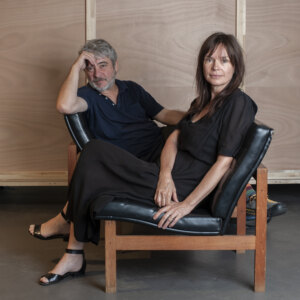
Massimo Furlan, theater director
Massimo Furlan was born in 1965 in Lausanne to Italian parents. After studying at the Lausanne Cantonal School of Art, he worked in his studio, regularly exhibited his paintings and drawings in various galleries, and worked as a set designer. In 2003, he founded the company Numero23Prod and began developing stage and performance works. In his early days, his work drew inspiration from his childhood memories: he used his personal story as a starting point to tap into the collective memory of an entire generation. He revisits models, dreams, and anecdotes that left a particularly deep impression on him and whose intensity still evokes surprise—as well as a certain sense of joy—even today. Examples include projects such as *Gran Canyon Solitude* (2003), *(love story) Superman* (2004), *Palo Alto* (2006), and *Les filles et les garçons* (2007). In his stage projects, he invites dancers and other performers onto the stage to create what he calls “long images”: sequence shots that blend elements of cinema and installation art. He continues this exploration with *You Can Speak, You Are an Animal* (2009), *Schiller Thriller* (2011), *Giacomo* (2012), and *Un Jour* (2014).
Alongside his stage projects, he has been active in the field of performance art, notably reenacting—alone and without a ball—legendary moments from soccer history in stadiums across Europe (beginning in 2000), he ran on the runway at Geneva International Airport for the Festival de la Bâtie in 2004 in *International Airport*, and he ran through the Great St. Bernard Tunnel connecting Switzerland to Italy for *Tunnel* in 2015. He also portrayed all the contestants from the 1973 edition of the Eurovision Song Contest for the Avignon Festival in 2010.
Beginning in 2008, with his dramaturg Claire de Ribaupierre, he devised unique protocols and devices for speech as part of projects such as *Chanteur plutôt qu’acteur* (2008), *Les Héros de la pensée* (2012–2018), *Après la fin, le Congrès* (2015), and *Le Concours européen de la chanson philosophique* (2019), which feature thinkers on stage.
In 2017, his work took on a documentary dimension, incorporating non-professional actors—villagers from the Basque Country for the 2017 project *Hospitalités*, and migrant workers for *Les Italiens* in 2019. This approach, which raises the question of who is on stage and who is telling the story, continues with projects such as *Avec l’animal* (2022), *Les feux* (2023), and *Dans la terre* (2024), which explore gestures and craftsmanship.
Another aspect of the work involves taking audiences on nighttime journeys by train, bus, or boat to explore urban or wild landscapes through contemplation, music, and walking—much like a long cinematic tracking shot: examples include *Girls Change Places* (2004), *The Wind in the Wood* (2016), *Nocturne* (2017), *Travelling* (2017), *Factory* (2017), and *Dans la forêt* (2020). Massimo Furlan received the Swiss Theater Prize in 2012, and his work is supported by a joint agreement between the City of Lausanne, the Canton of Vaud, and Pro Helvetia, the Swiss Arts Council.
Claire de Ribaupierre, playwright
Claire de Ribaupierre, born in 1968 in Lausanne, studied humanities and earned a Ph.D. in contemporary literature. She conducts research in the fields of anthropology, visual culture, and literature. She has published *Le roman généalogique. Claude Simon and Georges Perec (2002), and has edited numerous anthologies on the themes of mourning and the ghost (Le corps évanoui, les images subites, 1999), the figure of the idiot (2004), and the nature of the anecdote (2007). In October 2012, in collaboration with the Neuchâtel Art Center, she edited *Les Héros de la pensée*, a book chronicling the 26-hour performance and 11 philosophical songs (2019) for the European Philosophical Song Contest project. Since 2003, she has collaborated on Massimo Furlan’s productions, first as a performer and later as a dramaturg.
She has served as a research fellow and instructor at the Valais Cantonal School of Art as well as at the Geneva University of Art and Design. She has organized several gatherings at art venues bringing together artists and theorists to explore specific themes (anecdotes, archives, animals, accidents, excesses, etc.). From 2008 to 2010, she worked as a researcher funded by the Swiss National Science Foundation on artistic practices related to the archive, as well as on a project exploring improvisational practices in collaboration with several art, theater, and music schools. She currently teaches methodology, dramaturgy, and anthropology at La Manufacture—Haute école des arts de la scène, as part of the Bachelor’s program in theater and dance.
Aurélien Godderis – Chouzenoux, Sound
Trained at the Conservatory of Rennes (FR) in piano, Aurélien Chouzenoux graduated from INSAS—the National Higher Institute of Performing Arts—in Brussels (BE), specializing in sound. Since 1996, he has been creating compositions and recordings for music, live performance, and the world of sound. In music, he produces for the labels Rosebud (he contributed to the album by Philippe Katerine & Anna Karina), Expressillon (Paris), Reload (Ghent), Station 55 (Barcelona), Subsounds (Brussels), Kompakt (Cologne), Boucherie (Paris), and Les Hérétiques (Lausanne). He directed, produced, and composed the albums *Chant d’entre les immeubles* and *Complaintes de la pluie qui passe* by Stéphane Blok, for which he received the Charles Cros Prize for composition, production, and arrangements. He created the sound design for the Devialet Acoustic Engineering House (Paris) and participates in the activities of Musiques & Recherches, the acousmatic section of the Royal Conservatory of Mons, Belgium. For the Kunstenfestival des Arts (Brussels) and La Villette (Paris), he created an audiovisual installation based on the work of Henri Michaux. He also participated in Dominique Balay’s international project Meanwhile Fukushima (France Culture/Radio Campus/Monophonic Festival/RS). He has produced more than forty works for the performing arts over the past 20 years, including for the Compagnie Michèle Noiret (Brussels), the Compagnie Jours Tranquilles (which he founded with Fabrice Gorgerat and Estelle Rullier), the Cie Clinic Orgasm Society (Brussels), Rodrigo Garcia (formerly of Geneva/Madrid), the Osmosis Company (Nancy/Forbach), the Que Cirque Company (Paris, La Villette), the Marielle Pinsard Company (Lausanne), the Nicole Seiler Company (Lausanne), and the Sur un malentendu Collective (Lausanne). He leads various workshops on sound in the performing arts in Rennes (France), Cape Town and Johannesburg (South Africa), Maputo (Mozambique), Brazzaville (Congo), Ouagadougou (Burkina Faso), Montreal (Canada), and Bengaluru (India).
Julie Monot, Makeup Artist
Julie Monot lives in Lausanne, where she was born in 1978. In 1997, she moved to London, where she earned a BTEC in makeup artistry; following this, she assisted various international makeup artists and, as part of this work, traveled for three years. Upon returning to Switzerland, she developed new specialized technical skills, such as wig-making and the creation of masks and prosthetics. Since then, she has worked across the performing arts, the world of photography, and film, collaborating with visual artists and directors such as Dries Verhoeven, Jacques Lassalle, Philippe Sireuil, and Sibylle Stoeckli, among others. In 2014, she began her studies at HEAD (University of Art and Design) in Geneva (CH), where she pursued a Bachelor’s degree in visual arts. She completed this training with a Master’s degree at ECAL, the Lausanne University of Art and Design (CH). Her artistic practice spans various media, including performance, video, photography, and installation. Her explorations center on the body and the identities it embodies. Beyond representation, it is the tension between reality and fiction—which creates a space of confusion—that interests her.
Anna Van Bree, Costume
Anna van Brée (1964) studied fashion design in the Fashion Department at the Academy of Fine Arts in Antwerp before turning to theater directing (INSAS in Brussels, from 1984 to 1988). After several years as an assistant in France and Belgium (working notably with Franz Marijnen, Adriano Sinavia, and Sophie Rappeneau), she turned to costume design for theater and film. She then worked in Belgium, France, Switzerland, and the Netherlands with, among others, directors Philippe Sireuil, Ursula Meier, Jacques Delcuvellerie, Marianne Pousseur, Andrea Novicov, Anne Bisang, Gianni Schneider, and Guy Cassiers. She founded the Belgo-Swiss company in 2002.
Jérôme Vernez, Stage Manager
Born in 1977 in Lausanne (Switzerland), he entered the world of performing arts and street theater at a very early age, both as a writer-director and as a technician or street performer. Through a series of twists and turns, he specialized as a video technician and designer, primarily for the theater. From 2008 to 2018, he was head of the video department at the Théâtre de Vidy-Lausanne. On various productions, he has collaborated with artists such as Heiner Goebbels, Yeung Faï, Amit Drori, Charles Tordjmann, Séverine Chavrier, and others.